

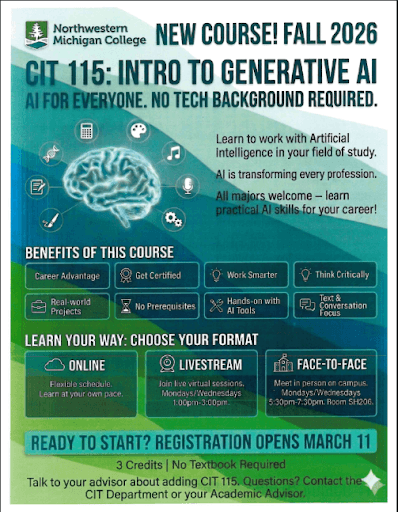
 Gen AI might not be coming for your job, but it is coming to the workplace. Soon, everyone will need at least some AI awareness in order to do their jobs, says CIT instructor Stewart Jack. That’s why he designed NMC’s new Intro to Generative AI elective with a career focus appropriate to all fields.
“We’re hoping this is going to be a class that is valuable for everybody at the college,” says Stewart, who developed the CIT 115 course debuting this fall. “Every single week, we’ll have projects that give students the opportunity to apply what they’ve learned within their area of study. If they’re going into general studies, they still have to pick a field that they’re interested in. That way they’re always relating AI to real-world practice within their field.”
At the end of the semester, students can test for a third-party certificate to boost their resumes. Recent reports show that AI fluency is a career advantage — if not a requirement — in all sectors, not just in tech. A recent survey by the compensation software company Payscale, for example, found that 61% of organizations have updated existing roles to include AI-related skills or competencies.
Although no programming background is required for CIT 115, the 15-week, 3-credit course does “go reasonably deep” into the technology, Stewart says. Students will learn foundational concepts of AI systems, the AI model life cycle, the differences between AI models, and how to choose an appropriate AI tool for various scenarios. They will learn how to use AI to produce different forms of media, including code for a website. They will also learn about ethical and security considerations and implications for learning and employment.
The most valuable aspect of the course, says Stewart, is learning about AI by using AI. Students will work their way through exercises that allow them to investigate issues of interest in their fields. They’ll use AI to assist their research and test their understanding, giving them more control over their learning. Through discussion and reflection, they will develop an organic understanding of how to work effectively with AI, including how much to trust its output.
Stewart is modeling the assignments for CIT 115 on his revamped coding classes. In the fall, he changed his online Python courses to a Gen AI format where students use AI to learn how to code with AI. Python students are given prompts to start, but are encouraged to explore the topic deeper with their own follow-up questions, depending on which aspects pique their curiosity. They then engage in a back-and-forth conversation as they generate and refine the code.
Stewart says that discussion boards help students develop the habit of sharing discoveries with their peers, and the posts reveal that students are genuinely learning from each other. He’s found that students are not only more engaged by their work with AI, they are also “connecting concepts that I haven’t been able to see and record before.”
Overall, the format is helping students develop a realistic understanding of how to work with AI.
“What my programming students are discovering is not just the strengths of AI, but the weaknesses as well,” Stewart says. “It’s a common myth that AI will replace programmers anytime soon. You ask any of my students, and they will tell you that AI is not able to produce consistent, reliable results. It’s useful as an assistant, but it’s not taking over. That’s part of what they learn.”