

What are Student Learning Outcomes?
Student Learning Outcomes (SLOs) are clear, concise statements that describe what students are expected to know, be able to do, or value as a result of a learning experience, such as a course, program, or degree. SLOs shift the focus from what is taught to what is learned, providing a roadmap for both instructors and students. SLOs are measurable and observable, allowing for effective assessment of student achievement and program effectiveness. They serve as a foundational element in curriculum design, guiding instructional strategies and assessment methods. All courses at NMC include SLOs designed using L. Dee Fink’s Taxonomy of Significant Learning.
Fink’s Taxonomy of Significant Learning
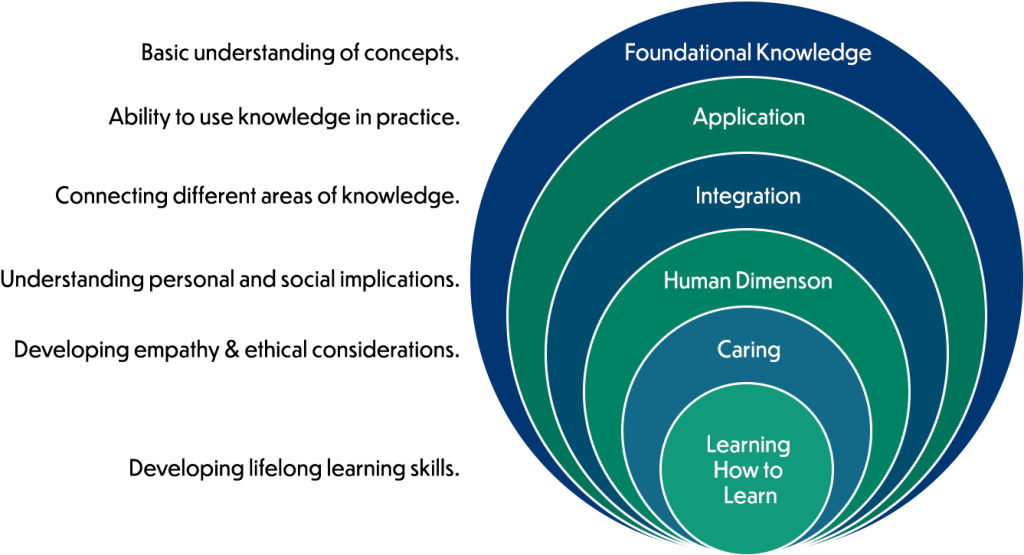
Unlike traditional taxonomies that often present learning as a hierarchy, Fink’s Taxonomy of Significant Learning is designed as an interactive and integrated model. It proposes six interconnected categories of learning, suggesting that significant learning often involves multiple dimensions working together. For each course at NMC, we strive to organize our SLOs using these categories to ensure a comprehensive and impactful learning experience. L. Dee Fink is a prominent figure in the field of higher education pedagogy and instructional design. His influential book, “Creating Significant Learning Experiences: An Integrated Approach to Designing College Courses,” is a widely used resource for educators seeking to enhance their teaching practices.
Foundational Knowledge
This dimension focuses on students understanding and remembering core information, facts, concepts, and ideas. It forms the essential building blocks for all other types of learning.
Action Verbs: Define, Describe, Explain, Identify, List, Name, Recall, Recognize, Remember, State, Summarize, Paraphrase, Illustrate.
Example SLOs:
-
- Define key terms related to historical periods.
- Summarize the main theories of cognitive development.
- Identify the major components of a cell.
Application
This involves students being able to use foundational knowledge and skills to solve problems, make decisions, or perform tasks. It encompasses critical thinking, creative thinking, and practical thinking.
Action Verbs: Apply, Calculate, Conduct, Create, Demonstrate, Design, Develop, Employ, Execute, Illustrate, Implement, Manage, Operate, Perform, Solve, Use, Utilize.
Example SLOs:
-
- Apply statistical formulas to analyze given data sets.
- Design a marketing campaign for a new product.
- Solve complex equations using learned algorithms.
Integration
This dimension emphasizes students making connections between different ideas, courses, experiences, and realms of life. It’s about seeing how concepts fit together and understanding their interrelationships.
Action Verbs: Analyze, Combine, Compare, Connect, Contrast, Correlate, Differentiate, Integrate, Interrelate, Link, Relate, Synthesize, Unify.
Example SLOs:
-
- Integrate economic theories with current political events.
- Compare and contrast different philosophical perspectives on ethics.
- Connect concepts learned in this course to real-world scenarios.
Human Dimension
This focuses on learning about oneself and others. It includes developing self-knowledge, understanding diverse perspectives, and enhancing interpersonal and collaborative skills.
Action Verbs: Advocate, Collaborate, Communicate, Cooperate, Empathize, Express, Interact, Lead, Mediate, Negotiate, Nurture, Reflect, Respect, Share, Support.
Example SLOs:
-
- Collaborate effectively in a team to complete a project.
- Reflect on their own biases when engaging with diverse viewpoints.
- Empathize with characters from different cultural backgrounds in literature.
Caring
This dimension is about developing new feelings, interests, and values. It signifies a change in attitude or a deeper appreciation for the subject matter, leading to a desire for continued engagement.
Action Verbs: Appreciate, Commit, Develop, Discover, Explore, Express, Identify (values), Interest (in), Pledge, Value, Renew, Revitalize.
Example SLOs:
-
- Develop a deeper appreciation for sustainable environmental practices.
- Express an interest in further research on a chosen historical topic.
- Value the importance of ethical considerations in scientific research.
Learning How to Learn
This metacognitive dimension focuses on students becoming better learners. It involves developing strategies for inquiry, self-assessment, and becoming self-directed in their learning journey.
Action Verbs: Analyze (learning process), Assess (one’s own learning), Construct knowledge (about learning), Critique (learning strategies), Develop (learning plan), Formulate (questions), Inquire, Predict (performance), Research (learning techniques), Self-assess, Self-monitor, Set goals (for learning), Transfer knowledge (about learning).
Example SLOs:
-
- Identify their preferred learning strategies and how they apply to new material.
- Critique their own problem-solving approaches to improve efficiency.
- Develop a personalized plan for continuous professional development.
Got Questions or Need Help?
Contact Ryan Bernstein (rbernstein@nmc.edu), NMC Curriculum & Instructional Designer, if you have questions or if you’d like help writing your Student Learning Outcomes. For more action verbs or example SLOs: Action Verbs for each Dimension of Fink’s Taxonomy.